FRP Grating Cover vs Concrete Trench Cover
FRP covers and concrete covers both seal trench openings, but their performance differs dramatically.
Key Engineering Considerations
FRP grating design requires careful selection of panel thickness, resin type, and span. This guide covers the essential parameters for engineers and specifiers.
| Parameter | Typical Range | Notes |
|---|---|---|
| Panel Thickness | 25-50 mm | #25 light, #38 standard, #50 heavy |
| Live Load | 2.4-24 kN/m2 | 5 kN/m2 standard pedestrian |
| Deflection Limit | L/120 to L/180 | L/180 for sensitive equipment |
| Safety Factor | 3:1 to 4:1 | 3:1 pedestrian, 4:1 forklift |
Resin Selection
Choose isophthalic for general wet environments, vinylester for strong chemicals, and phenolic for high-temperature service (120-150 C).
| Resin | Temp Limit | Relative Cost |
|---|---|---|
| Isophthalic | 60 C | 1.0x |
| Vinylester | 90 C | 1.3-1.5x |
| Phenolic | 120-150 C | 2.0-3.0x |
Installation Best Practices
Use SS316 clips at 300 mm spacing. Torque M6 bolts to 8-10 Nm. Leave 3-5 mm expansion gaps between panels. Install expansion joints every 6 m.
Engineering Standards and Certifications
FRP grating is governed by several international standards. ASTM E84 measures flame spread and smoke density — Class A is required for offshore and high-occupancy buildings. ISO 75 defines heat deflection temperature, which determines maximum service temperature. BS 4592 (now EN ISO 14122) specifies dimensions, load ratings, and testing methods for industrial flooring. ASTM D570 measures water absorption, which affects long-term dimensional stability. All ZeAllgrate products are tested to these standards, with certification documentation available on request.
Quality Control and Testing
Every batch of molded grating undergoes mechanical testing. Flexural strength is tested per ASTM D790 — minimum 172 MPa for isophthalic panels, 207 MPa for vinylester. Barcol hardness is checked per ASTM D2583 — typical range 40-50 for cured panels. Water absorption per ASTM D570 must be below 0.5%. Flame spread index per ASTM E84 must be below 25 for Class A. These tests ensure consistent quality across production runs.
Installation on Steel Supports
Grating panels must bear on steel supports with minimum 25 mm overlap at each end. Support beams should be sized to carry the grating weight plus live load without excessive deflection (L/250 max). Use hot-dip galvanized or stainless steel supports in corrosive environments. The support beam flange width should be at least 50 mm to accommodate clips. Spacing between support beams is determined by the grating span table — never exceed the rated span.
Maintenance and Inspection
FRP grating requires minimal maintenance. Annual visual inspection is sufficient for most applications. Check for: surface wear (grit top worn smooth), clip tightness (re-torque if loose), edge damage (cracks or delamination), and chemical staining (indicates resin degradation). Clean with water and mild detergent — do not use abrasive cleaners. For chemical service, inspect quarterly and replace panels showing blistering or softening.
Typical Project Specifications
A typical chemical plant walkway specification reads: "Molded FRP grating, 38 mm thickness, vinylester resin, grit-top surface, 1220×3660 mm panels, installed on galvanized steel supports at 1200 mm spacing, secured with SS316 G-clips at 300 mm intervals. Meets ASTM E84 Class B, EN ISO 14122, and ISO 9001 quality standards." This level of detail ensures consistent installation and performance.
Cost Analysis: FRP vs Steel vs Aluminum
FRP grating costs 2-3x more than galvanized steel per m². But over a 25-year lifecycle, FRP wins on total cost: steel requires painting every 3-5 years, replacement after 10-15 years in corrosive service. Aluminum is lighter but conductive and more expensive. FRP's non-corrosive, non-conductive properties make it the best choice for chemical, marine, and electrical applications despite higher upfront cost.
Common Applications by Industry
Chemical plants: vinylester molded grating on acid walkways. Water treatment: isophthalic molded grating on clarifier platforms. Marine/offshore: phenolic molded grating for fire-rated walkways. Food processing: FDA-compliant isophthalic grating on washdown areas. Power substations: pultruded FRP grating for non-conductive access. Each industry has specific requirements that determine resin type and panel specification.
Case Study: Brewery Trench Covers, Shandong
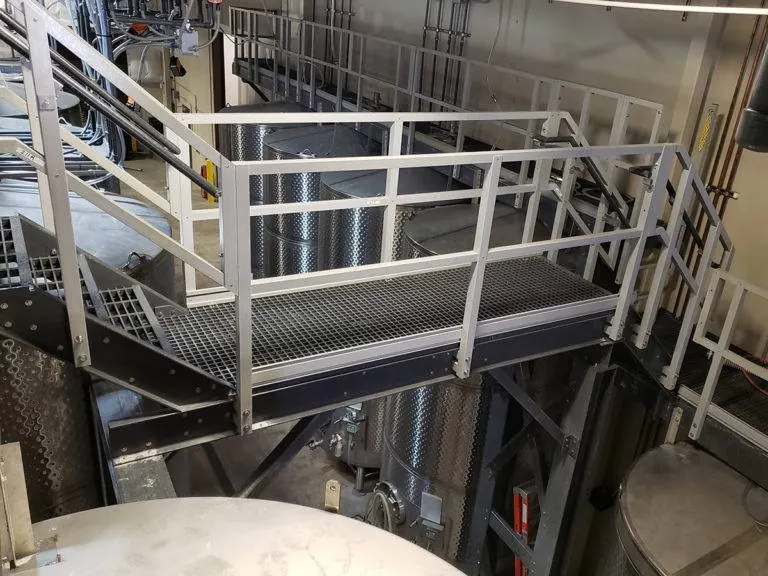
A brewery in Shandong replaced concrete trench covers (cracking from washdown chemicals and beer residue) with FRP grating covers. 150 m of 400 mm wide drainage trench in the brewhouse. Concrete covers: 40 kg each, cracked within 3 years from thermal cycling and chemical exposure. FRP covers: #38 isophthalic molded grating, 8 kg each, food-safe resin. One person lifts for daily cleaning access. Result: no cracking, easy cleaning, food-safe surface. Cost: FRP covers 3× concrete upfront, but concrete replacement every 3 years makes FRP cheaper over 10 years.
Calculation: Weight and Access Frequency
Concrete cover (400×1000×80 mm): weight = 0.4×1.0×0.08×2400 kg/m³ = 77 kg. Requires 2 workers or lifting equipment. FRP grating cover (400×1000 mm, #38): weight = 1.0 m² × 10 kg/m² = 10 kg. One person lifts. Access frequency for brewery daily cleaning: 2× per day. With concrete: 2 workers × 10 min × 365 days = 1,217 worker-hours/year. With FRP: 1 worker × 2 min × 365 days = 122 worker-hours/year. Labor savings: 1,095 hours/year — at $20/hour = $21,900/year. The FRP covers pay for themselves in under 1 year on labor savings alone.
Material Comparison Table
| Property | FRP Grating Cover | Concrete Cover |
|---|---|---|
| Weight (400×1000 mm) | 8-12 kg | 60-80 kg |
| Manual Lift | Yes | No |
| Corrosion Resistance | Excellent | Spalls, cracks |
| Load Rating | A15-B125 | C250-D400 |
| Service Life | 25+ years | 5-10 years (aggressive) |
| Relative Cost | 3.0x | 1.0x |
| Inspection Frequency | Annual | Semi-annual |
What is the Difference Between FRP and GRP Grating?
FRP (Fiberglass Reinforced Plastic) and GRP (Glass Reinforced Plastic) refer to the same material — glass fibers embedded in a thermoset resin matrix. The terms are used interchangeably in the industry. Fiberglass grating is the common product name. The key performance factors are: resin type (isophthalic, vinylester, phenolic), glass content (typically 65-70%), and manufacturing process (molded vs pultruded). Composite grating is another umbrella term that includes both FRP and other fiber-reinforced products.
How to Calculate Load Span for Walkway Grating
Calculating load span for walkway grating requires three inputs: 1) live load (PSF or kN/m²), 2) allowable deflection (L/120 or L/180), and 3) panel thickness and resin. Use the formula: δ = (5wL⁴)/(384EI). Rearrange to solve for L: L = (384EIδ/5w)^(1/4). For a #38 isophthalic panel at 5 kN/m² with L/180 deflection (δ = L/180), the maximum span is approximately 1.2 m. This matches published load-span charts. Always verify with engineering for concentrated loads or dynamic loading.
Why Choose Corrosion Resistant Grating Over Steel?
Corrosion resistant grating (FRP/GRP) outperforms steel in three key areas: 1) Chemical resistant grating survives acid, alkali, and solvent environments where steel rusts within months. 2) Offshore grating and marine grating never rust from salt spray — steel requires repainting every 2-3 years. 3) Wastewater grating handles H₂S and moisture without degradation. FRP vs steel lifecycle cost: FRP is 2-3× upfront but 40-60% cheaper over 25 years when maintenance and replacement are included.
Platform Grating Design Considerations
Platform grating design differs from walkway grating: platforms carry equipment loads, not just pedestrian traffic. Typical equipment loads: 5-20 kN/m² depending on equipment weight. Use #50 vinylester or pultruded I75 for equipment platforms. Add stiffeners under concentrated loads (e.g., valve stands, pump bases). Stair tread grating requires special nosing and anti-slip surfaces — use T-bar profiles with bonded yellow nosing for visibility.
Composite Grating Standards and Testing
Fiberglass reinforced plastic grating is tested per: ASTM D790 (flexural strength), ASTM D638 (tensile), ASTM E84 (flame spread), ISO 75 (heat deflection), BS 4592 / EN ISO 14122 (industrial flooring). Each test ensures consistent quality. Request test reports with every order. Typical values: flexural strength 172-207 MPa, flexural modulus 8-12 GPa, water absorption <0.5%.
Resin Selection for Chemical Resistance
Resin selection is the most critical design decision for chemical resistant grating. Isophthalic: general wet areas, dilute acids. Vinylester (Derakane 411): strong acids, alkalis, solvents. Phenolic: high temperature (120-150°C) and fire-rated (ASTM E84 Class B). When in doubt, request chemical resistance charts from the manufacturer. For unknown chemicals, run coupon immersion tests before specifying.
FRP Structural Profiles for Support Frames
FRP structural profiles (I-beams, channels, angles, tubes) complement grating systems. FRP I-beam replaces steel in corrosive frames. FRP angle replaces steel angle in marine and chemical supports. FRP channel provides C-shaped sections for framing. All profiles are pultruded with continuous glass roving for maximum strength along the length. Use SS316 mechanical connections — do not weld.
FRP Grating Covers and Clips System
FRP grating covers seal trench openings and floor penetrations. FRP grating clips secure panels to support beams. The complete system includes: G-clips (standard edge), S-clips (panel junction), M-clips (heavy-duty), and through-bolt clips (fixed ends). Use SS316 clips for marine and corrosive service; 304 is acceptable for indoor dry areas. Torque M6 clips to 8-10 N·m, M8 to 15-18 N·m.
Common Installation Mistakes and How to Avoid Them
After 15 years of fiberglass grating projects, we see the same mistakes repeatedly. First: over-torquing clips — this cracks the laminate around the bolt hole, leading to premature failure. Always use a torque wrench. Second: undersized support beams — beams deflect under grating weight, causing the grating to vibrate and fatigue. Size beams for L/250 deflection. Third: no expansion joints — molded grating expands 0.06 mm/m/°C; without joints, panels buckle in summer. Fourth: wrong clip material — using 304 clips in coastal service causes rust staining within a year. Always use SS316 for outdoor or corrosive service. Fifth: grinding cut edges — exposed glass fibers are sharp; grind smooth and apply edge sealant.
What Standards Govern FRP Grating Installation?
Installation follows EN ISO 14122 (machinery safety — permanent access means), BS 4592 (industrial flooring), and OSHA 1910.28 (walking-working surfaces). Key requirements: minimum 25 mm bearing overlap, clip spacing ≤ 300 mm, anti-slip surface for wet areas, handrails on platforms over 1.0 m height. FRP vs steel installation procedures are similar — both require support beams and clips. The main difference: FRP cannot be welded, so all connections are mechanical (SS316 bolts/clips).
How to Specify FRP Grating for Your Project
A complete specification includes: panel type (molded/pultruded), thickness (#25/#38/#50 or I38/I50/I75/I100), resin (iso/VE/phenolic), surface (grit-top/smooth), dimensions (1220×3660 mm standard), clips (G/S/M type, SS316), and standards compliance (ASTM E84, EN ISO 14122). Example: "Molded GRP grating, #38 vinylester, grit-top, 1220×3660 mm panels, SS316 G-clips at 300 mm spacing, EN ISO 14122 compliant." Send this specification to multiple manufacturers for comparison quotes.
Why Fiberglass Reinforced Plastic is Replacing Steel
The shift from steel to fiberglass reinforced plastic in industrial flooring is driven by three factors: 1) Lifecycle cost — FRP has 25-year zero-maintenance life vs steel's repaint-and-replace cycle. 2) Safety — FRP is non-conductive (no shock hazard) and non-sparking (no ignition risk in explosive atmospheres). 3) Weight — FRP is 1/4 the weight of steel, reducing structural load and installation labor. In chemical, marine, and wastewater industries, FRP is now the default spec. Steel is retained only for heavy vehicle loads (C250/D400) where FRP is not rated.
Frequently Asked Questions
What is the maximum span for FRP grating?
Depends on panel thickness and load. #38 vinylester typically spans 1.0-1.3 m at 5 kN/m2 with L/180 deflection.
Which resin should I use for chemical service?
Vinylester for strong acids and alkalis. Isophthalic for general wet environments. Phenolic for high-temperature applications.
How do I calculate grating span?
Identify live load, select panel thickness, choose resin, and read span from load tables. Confirm with engineering.