
Power & Energy FRP Grating Solutions
Why Power & Energy Needs FRP
Power plants and substations live with two enemies: corrosion (cooling water, chemicals, coastal salt) and electricity (conductive structures near live equipment). FRP is non-conductive, corrosion-proof and maintenance-free — engineered for the energy sector.- Electrical safety near live equipment
- Cooling tower and water chemistry corrosion
- Coastal salt exposure at power stations
- Maintenance access in hard-to-reach locations
ZeAllgrate Solutions for Power & Energy
ZeAllgrate non-conductive grating, cable tray walkways and handrail systems protect workers and equipment in power generation, transmission and distribution facilities. The same non-conductive, corrosion-proof FRP is engineered for power & electrical substation structures, switchyard access and transformer-yard decks.
Typical Applications
Substation access platforms
Cooling tower decks
Boiler room walkways
Cable tray support systems
Turbine hall platforms
Switchyard access
Project Gallery
Real ZeAllgrate FRP grating products and installations in service across this industry.
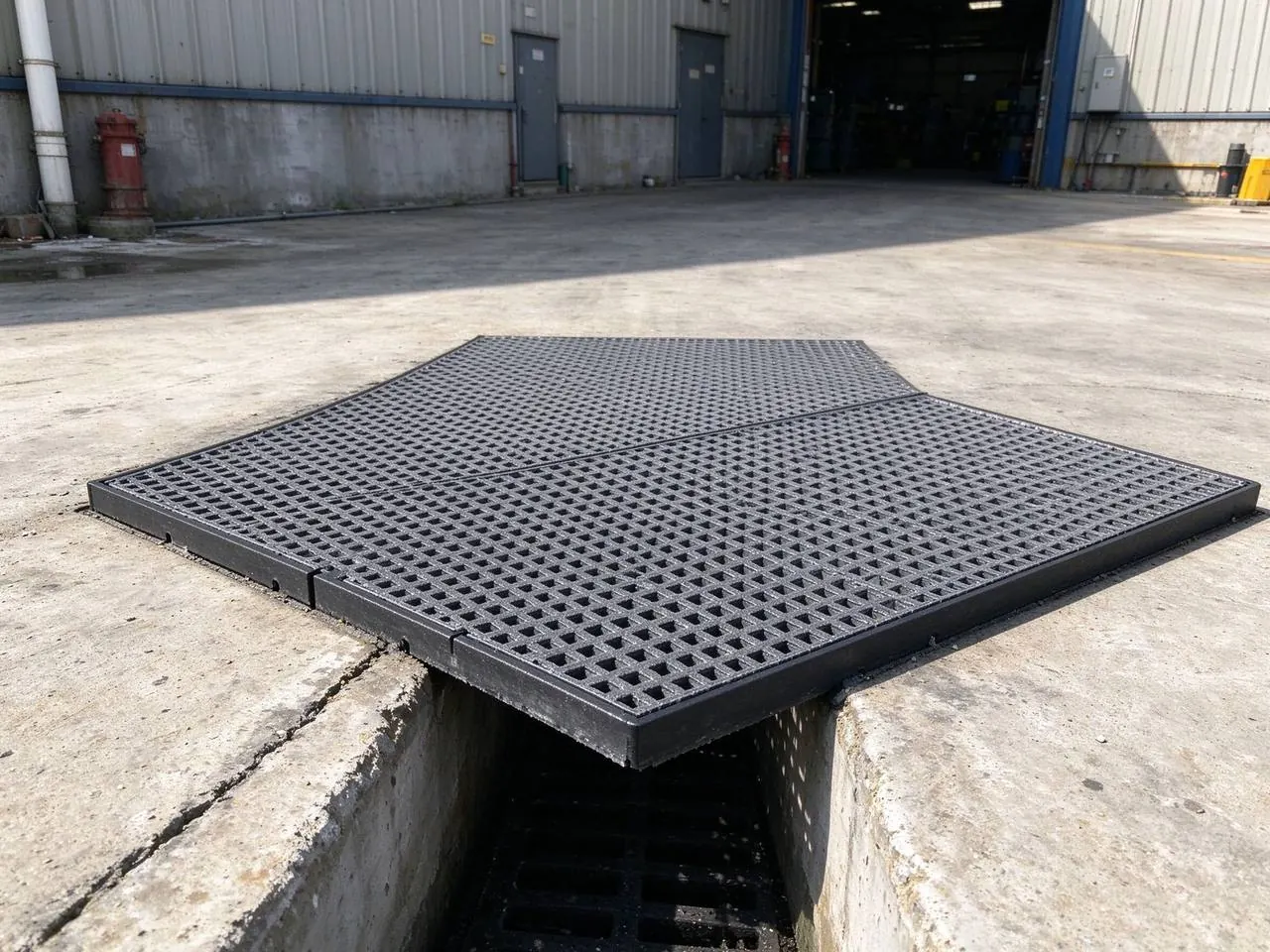
FRP trench cover for substation cable runs
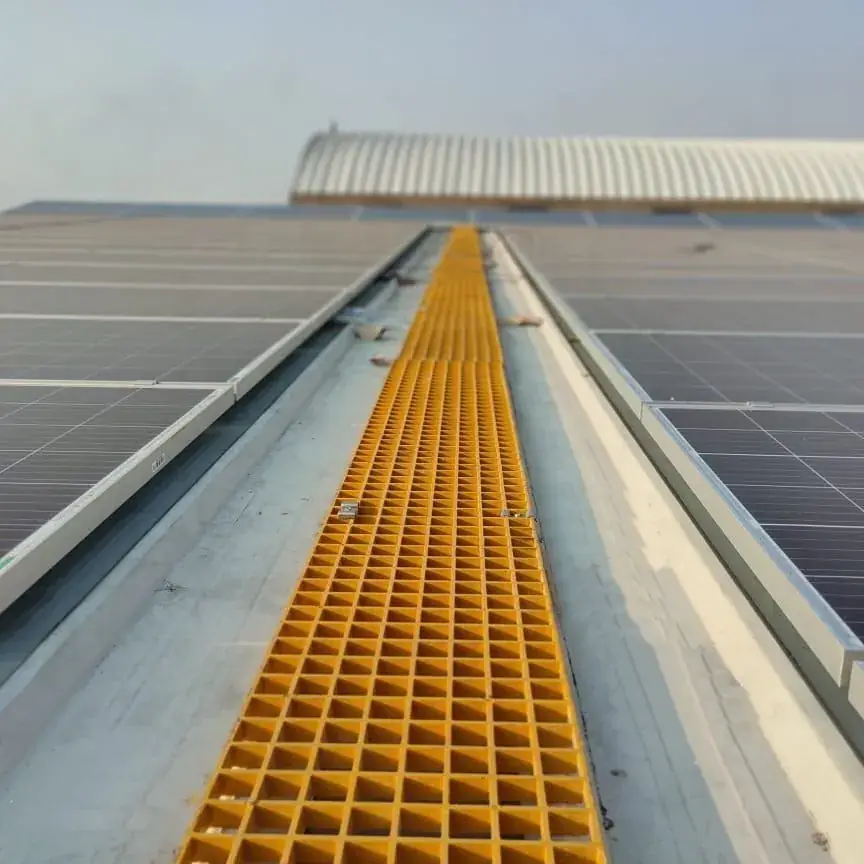
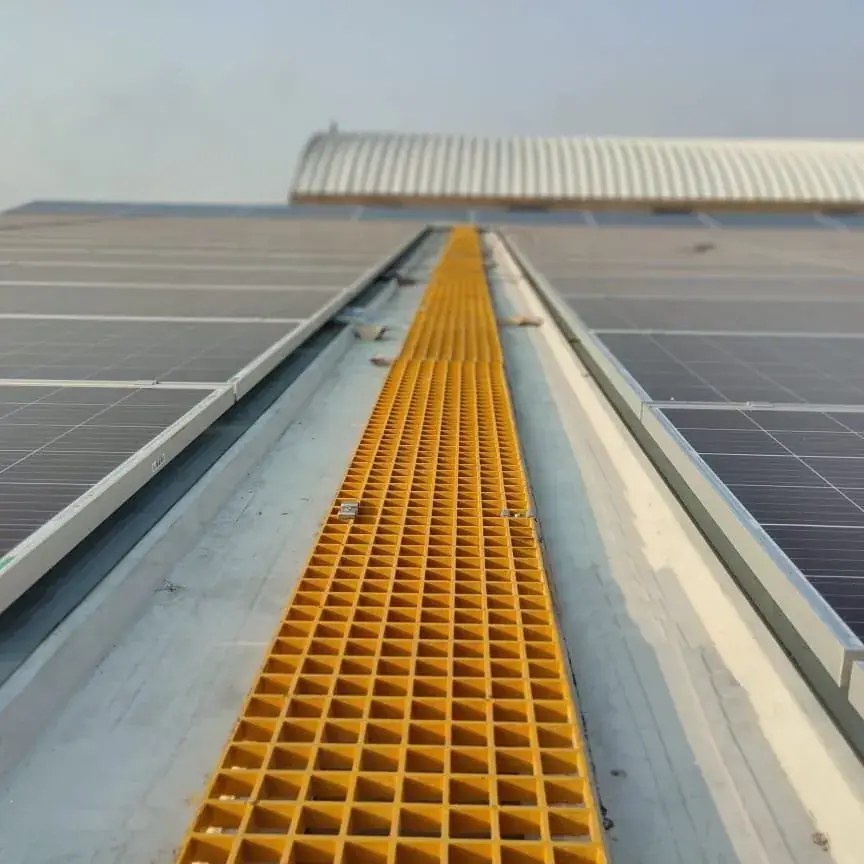
FRP access walkway through a photovoltaic array
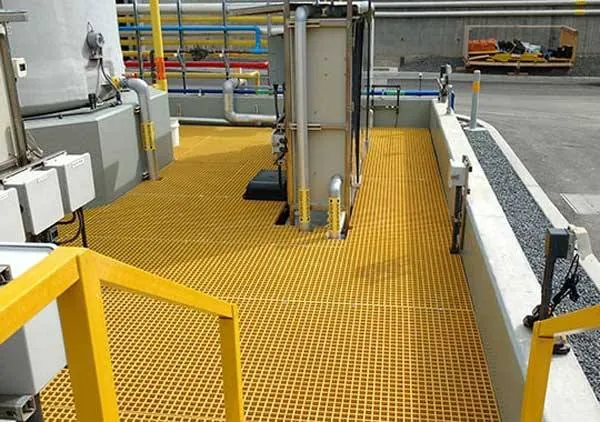
Non-conductive FRP stair tower at a power facility
Solutions for Every Process Area
Engineered FRP solutions mapped to each stage of your facility — from corrosive process zones to high-traffic access routes.
Non-conductive access platforms and cable trays in turbine halls.
Heavy-duty covers for cable trenches and duct banks.
Insulating, non-magnetic grating for electrical areas.
Fire-retardant walkways around boilers, stacks and ductwork.
Corrosion-proof walkways and covers for cooling water intakes.
Technical Specifications & Compliance
Application-specific engineering reference for Power & Energy — corrosion rating, load criteria, governing codes and the recommended ZeAllgrate configuration. Use this as the specification starting point; final design must be verified against certified load/span charts and the project's governing codes.
| Parameter | Specification for Power & Energy |
|---|---|
| Corrosion Level | Medium–High Cooling-water chemistry and coastal salt at coastal stations; plus electrical conductivity risk near live gear. |
| Typical Load Requirements | Substation & turbine-hall access 50 psf (2.4 kN/m²); cable-tray & equipment platforms 100 psf (4.8 kN/m²); switchyard access also requires non-magnetic, non-conductive behavior. |
| Applicable Standards & Regulations | OSHA 1910.23 & 1910.29, IEEE (substation grounding & clearances), ANSI C2 (National Electrical Safety Code), ISO 14122, ASTM E84 (boiler/stack areas), NEC Article 314 (wireway covers). |
| Recommended Resin System | ZeAll ISO for general plant; ZeAll VE for cooling-water & coastal exposure; ZeAll FR fire-retardant grade near boilers, turbines and transformers; all grades electrically non-conductive. |
| Recommended Grating Type | Molded 38.1 mm for substation & cable-tray walkways; Pultruded I5020 for long-span turbine-hall platforms; solid covers for cable trenches; non-magnetic reinforcement throughout. |
Resin systems: ZeAll VE (vinyl ester — severe corrosion), ZeAll ISO (isophthalic polyester — general service), ZeAll FDA (food/potable grade), ZeAll FR (extra flame-retardant), Phenolic (fire/smoke-critical). Grating types: Molded (bi-directional), Pultruded (long-span), Mini-Mesh (fine openings), HLC (high-load capacity).
Typical System Configuration
A non-conductive FRP access package for a power station — isophthalic grating over cooling-tower / cooling-water areas, vinyl ester near transformers and switchgear, with FRP clips where full electrical isolation is required. The defining selection criterion is dielectric integrity near live equipment, not just corrosion.
Component List
| Component | Product / Model | Material / Resin | Key Spec | Quantity / Ratio |
|---|---|---|---|---|
| Grating panels | ZeAllgrate Molded 38mm | ZeAll ISO (cooling tower) / ZeAll VE (transformer), concave + grit-top | 38.1 mm thick, ~70% open, non-conductive | Substation, cooling-tower and transformer walkways |
| Handrail system | ZeAll ISO / VE tube handrail | ZeAll ISO/VE tubes, SS304 fittings | 42.4 mm posts, mid-rail, toeboard | Perimeter and open edges |
| Support structure | Pultruded profiles | ZeAll ISO / VE | Non-conductive structural members | Long-span supports |
| Clips & fasteners | FRP clips (transformer) / SS304 clips (cooling tower) | FRP composite / SS304 | FRP clips for full electrical insulation | 2 clips per panel |
| Edge banding | FRP edge banding | ZeAll ISO / VE, dielectric | 3 mm protective trim | Panel perimeter |
Design Parameters Summary
| Design Parameter | Value for Power & Energy |
|---|---|
| Load rating | Pedestrian 3.0–3.5 kN/m² (~63–73 psf) |
| Span | 0.9–1.0 m panel span |
| Deflection limit | L/150 under design load |
| Resin selection rationale | Isophthalic (ZeAll ISO) for cooling tower UV/humidity; vinyl ester (ZeAll VE) for transformer chemical + dielectric duty |
| Surface type | Concave + grit-top for anti-slip access |
| Fastener material | FRP clips for full electrical insulation; dielectric strength > 10 kV/mm |
Applicable Standards & Codes
- OSHA 1910.23 / 1910.29 (ladders & guardrails)
- ISO 14122-1/-2/-3/-4 (permanent machinery access)
- ASTM D495 / D149 (arc resistance and dielectric strength)
- IEEE C2 (National Electrical Safety Code / NESC)
- NFPA 70E (electrical safety in the workplace)
In a power station the dominant risk is touching live gear through a conductive floor, so the system is engineered around electrical isolation first. FRP clips replace stainless hardware in transformer and switchyard zones to preserve a continuous insulating path, and dielectric strength is specified above 10 kV/mm rather than assumed. Resin is then matched to chemistry: isophthalic holds up in the perpetually wet, UV-exposed cooling tower, while vinyl ester is chosen where transformer oil, cleaning solvents and higher dielectric demand meet. Pultruded non-conductive profiles carry the long spans without introducing any metal cross-bridge.
Power & Energy Service Requirements
| Requirement | ZeAllgrate Response |
|---|---|
| Electrical insulation | Non-conductive grating near live equipment |
| Cooling tower service | Vinyl ester + UV-stabilised grades |
| Fire performance | E84 Class B/B/C per code for rated areas |
| Boiler / turbine access | Heat- and corrosion-resistant platforms |
Specification Guidance
Power plants value FRP for the electrical insulation: substation and switchyard decks need no earthing burden, and cooling tower zones get vinyl ester and UV-stabilised construction for the chlorinated water and sun exposure. Confirm the E84 class for rated areas, design the access decks to the load and deflection table, and use SS316 hardware in the wet zones. The lightweight panels install quickly on existing steel without hot work.
Go Deeper with the ZeAllgrate Knowledge Base
Electrical Insulation: Why FRP in Substations
FRP's primary advantage in power substations is electrical insulation: surface resistance ≥10¹² Ω·cm, no RF reflection, no magnetic interference. Steel walkways in a switchyard require bonding and earthing; FRP does not. We supply two grades for different substation zones:
| Zone | Surface resistance | Application | Standard |
|---|---|---|---|
| General access | ≥10¹² Ω·cm (high) | Molded GRP walkways, handrails | EN 14122, OSHA 1910.23 |
| Drum / battery handling | 10⁶–10⁹ Ω·cm (anti-static) | Anti-static molded panels | IEC 61235, EN 1082 |
| Live-line maintenance | Class II / IV per IEC 61215 | Pultruded FRP ladders & platforms | IEC 61235 |
Load & Span for Substation Walkways
Substation walkways carry maintenance crews, 20 L acid drums, and insulated hot-stick equipment. Typical ZeAllgrate picks:
| Application | Panel | Span | Live load | Surface grade |
|---|---|---|---|---|
| Switchyard access | 38 mm molded GRP | 1.2 m | 5 kN/m² | High-resistivity |
| Battery room / drum area | 38 mm anti-static molded | 1.2 m | 5 kN/m² | Anti-static 10⁶–10⁹ |
| Transformer platform | 50 mm pultruded I-bar | 2.0 m | 7.5 kN/m² | High-resistivity |
Handrails per EN 14122 / OSHA 1910.23: top rail 50×50 mm rectangular tube, mid-rail and toeboard, load-tested 0.74 kN/m² horizontal and 1.12 kN point. SS304 clips acceptable in dry indoor substations; SS316 where outdoor or coastal.
Reference: French 400 kV Substation
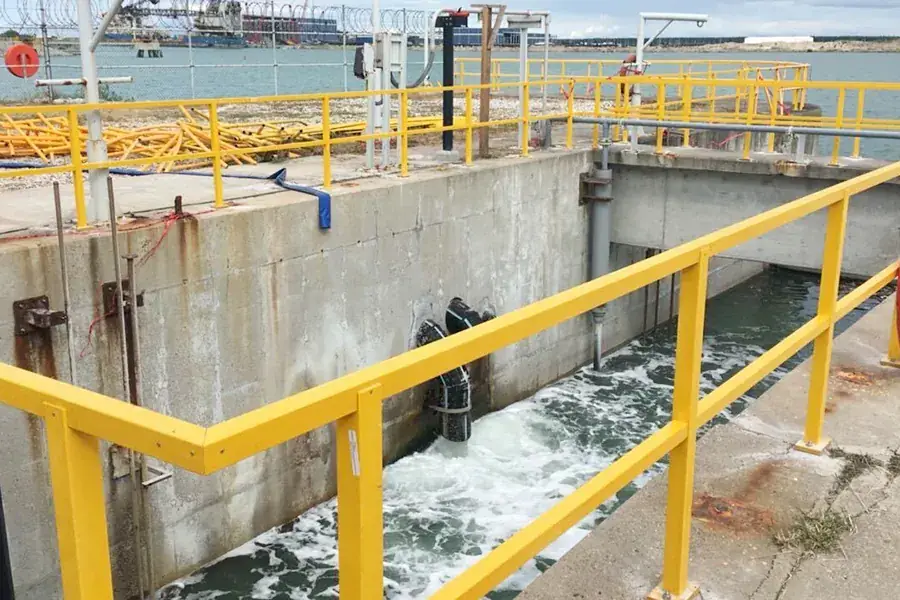
A French 400 kV substation replaced its steel walkways after corrosion from winter de-icing salts. We supplied:
- 38 mm high-resistivity molded GRP for general access walkways.
- Anti-static grade (10⁶–10⁹ Ω·cm) in the drum-handling zone.
- Bonded FRP handrails meeting EN 14122 and IEC 61235.
- Cut edges sealed with resin gel-coat on site to prevent water wicking into E-glass.
The switchyard has not required walkway repainting since — steel needed annual touch-up.
Anti-Static vs. High-Resistivity: When to Switch
A common mis-specification in substations: using high-resistivity GRP everywhere, including drum-handling and battery rooms. High surface resistance means static charge builds up and can discharge into sensitive equipment or hydrogen atmosphere. We switch to anti-static grade in two zones:
| Zone | Surface resistance | Reason | Standard |
|---|---|---|---|
| General switchyard access | ≥10¹² Ω·cm (high) | Worker insulation from live busbar | EN 14122 |
| Battery room / drum handling | 10⁶–10⁹ Ω·cm (anti-static) | Dissipate static; hydrogen / acid vapour | IEC 61235, EN 1082 |
| Control cabinet plenum | 10⁹–10¹¹ Ω·cm (intermediate) | Dissipate but not conductively | Contact engineering |
Why Not Steel in a Substation?
Steel walkways in a switchyard are not just a corrosion problem — they are an electrical problem. Three reasons substations convert to FRP:
- Bonding and earthing: every steel walkway needs bonding jumpers and earthing. FRP does not — it is inherently insulating, removing a class of safety inspections.
- RF reflection: steel near switchgear reflects RF signals and can interfere with protection relays. FRP is RF-transparent. This is why pultruded FRP handrails replace steel in A60 fire-wall transitions.
- Corrosion from de-icing salts: winter road salt on coastal or northern substations attacks steel within 5 years. FRP walkways in those zones need zero repaint.
The 10-year TCO on a French 400 kV substation conversion was 0.7× steel — accounting for avoided bonding jumpers, avoided repaint, and avoided relay-interference incidents. See our FRP vs. steel engineering guide.
Specification Checklist for Substation FRP
Substation specs fail when the electrical and structural requirements collide. Confirm every item:
- Zone: general access, battery/drum handling, live-line maintenance, control cabinet plenum. Each has a different surface-resistivity class.
- Surface resistivity: high (≥10¹² Ω·cm) for worker insulation; anti-static (10⁶–10⁹ Ω·cm) for drum/battery zones; intermediate (10⁹–10¹¹) for control plenum.
- Handrail load: EN 14122 / OSHA 1910.23 — 0.74 kN/m² horizontal, 1.12 kN point. Top rail 50×50 mm rectangular tube.
- Span & load: switchyard walkway typically 1.2 m span, 5 kN/m²; transformer platform 2.0 m span, 7.5 kN/m².
- Hardware: SS304 acceptable in dry indoor substations; SS316 where outdoor or coastal.
- RF / magnetic interference: FRP is RF-transparent — why we replace steel handrails in A60 fire-wall transitions.
- Winter salt exposure: northern or coastal substations see de-icing salts; FRP removes the annual repaint cycle.
Download our substation FRP specification guide or email [email protected].
FRP vs. Steel in a Substation: The Insulation Argument
In a substation, the FRP-vs-steel decision is not about corrosion (though that matters in winter-salt zones) — it is about electrical insulation and RF transparency.
| Factor | Steel walkway | FRP walkway |
|---|---|---|
| Electrical insulation | Bonding jumpers + earthing required | Inherently insulating (≥10¹² Ω·cm) |
| RF / magnetic interference | Reflects RF near switchgear | RF-transparent |
| Winter salt corrosion | Annual touch-up paint | Zero repaint |
| Anti-static grade | N/A | 10⁶–10⁹ Ω·cm for drum/battery zones |
The French 400 kV substation reference converted to FRP after winter-salt corrosion failures; 10-year TCO was 0.7× steel including avoided bonding jumpers and repaint cycles.
Have a Power & Energy Project?
Send us your application and environment details — our engineers respond within 24 hours with a technical solution.
Why FRP Grating for Power & Energy?
FRP grating for power generation: non-conductive, flame-retardant phenolic options. Substation platforms, cable trench covers, transformer areas.