Chemical Processing FRP Grating Solutions
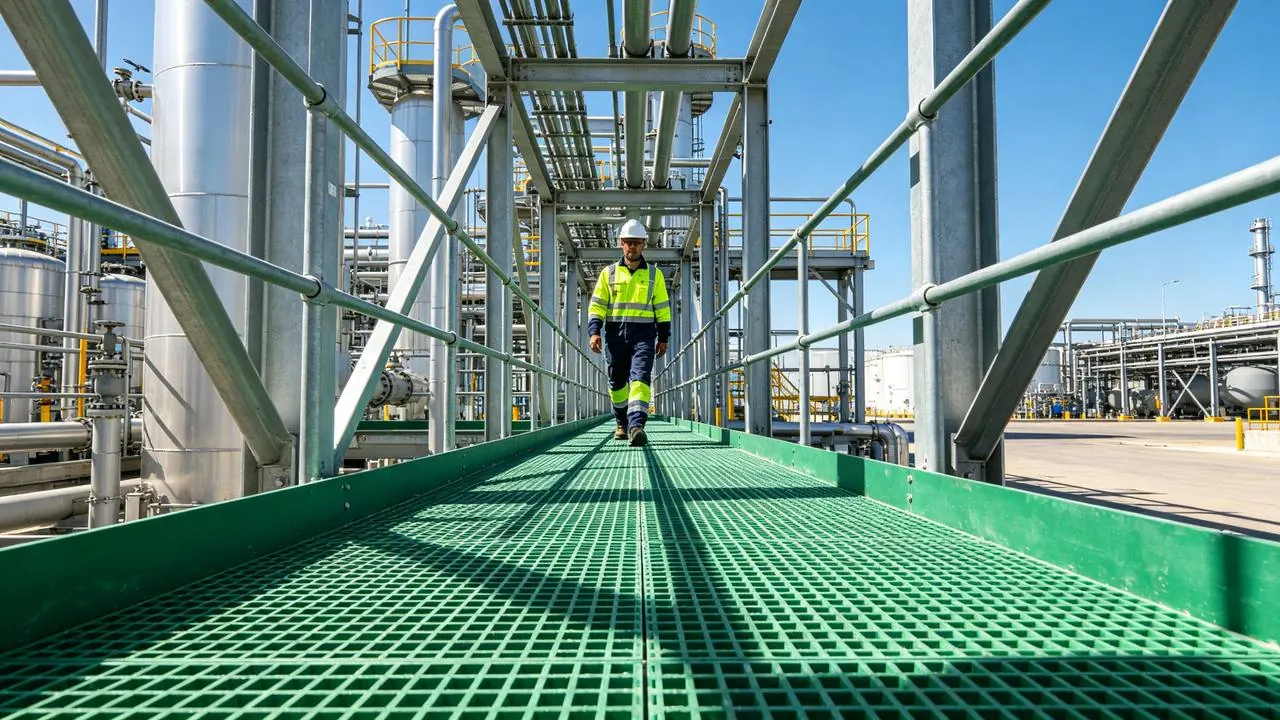
Why Chemical Processing Needs FRP
Chemical plants combine aggressive process atmospheres — acids, caustics, solvents and chlorides — with constant moisture. Carbon steel corrodes within months; painted structures demand endless maintenance. FRP is the material engineered to survive.- Acid & alkali vapor attack on steel structures
- Solvent splash and chemical spill exposure
- Secondary containment and trench systems that must not corrode
- Walkways over process equipment requiring spark resistance
ZeAllgrate Solutions for Chemical Processing
ZeAllgrate supplies molded and pultruded grating, covers and handrail systems with 3+ resin formulations matched to your specific chemical environment — from isophthalic polyester for general service to vinyl ester and phenolic for aggressive oxidizers.
Typical Applications
Process unit platforms
Pipe rack walkways
Drain trenches & covers
Secondary containment
Loading & unloading platforms
Tank farm access
Project Gallery
Real ZeAllgrate FRP grating products and installations in service across this industry.
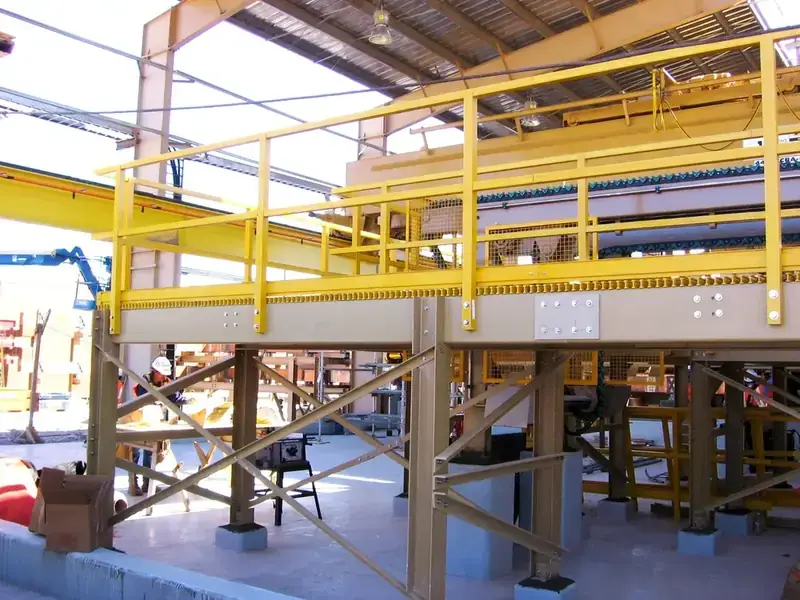
Steel-framed FRP grating platform over chemical process units
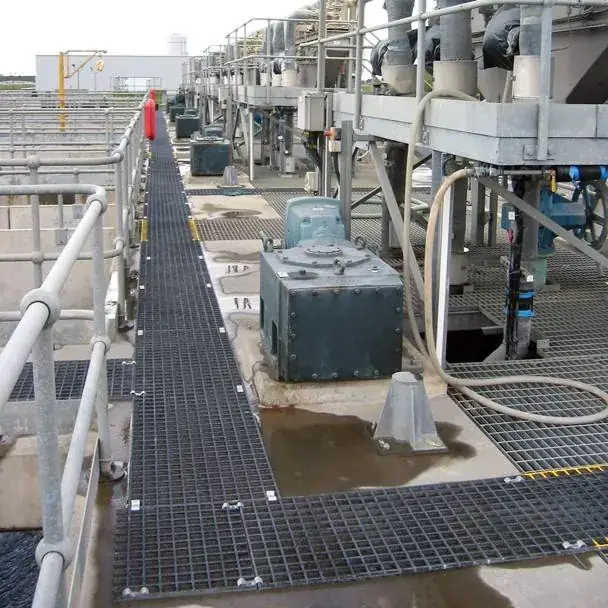
Long-span pultruded walkway over chemical storage tanks
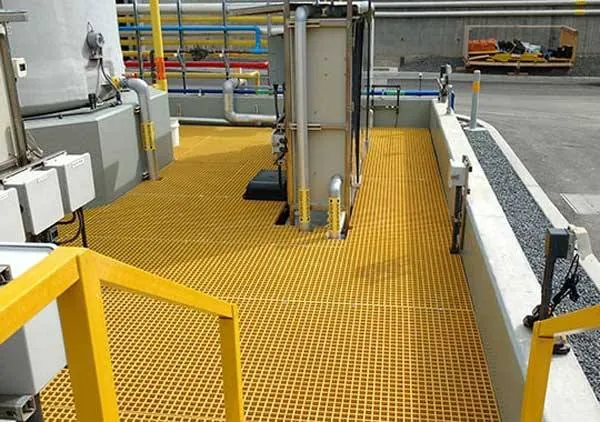
FRP grating platform over chemical process pipework
Solutions for Every Process Area
Engineered FRP solutions mapped to each stage of your facility — from corrosive process zones to high-traffic access routes.
Secondary containment, dike crossings and tank access platforms resisting acid and alkali atmospheres.
Long-span pultruded walkways over process lines with fire-retardant options.
Non-conductive, chlorine-resistant platforms and cell-room walkways.
Truck and rail loading platforms built from molded grating and covers.
Scrubber platforms and chemical treatment trenches that must not corrode.
Maintenance access platforms and inspection walkways around reactors, columns and heat exchangers.
Technical Specifications & Compliance
Application-specific engineering reference for Chemical Processing — corrosion rating, load criteria, governing codes and the recommended ZeAllgrate configuration. Use this as the specification starting point; final design must be verified against certified load/span charts and the project's governing codes.
| Parameter | Specification for Chemical Processing |
|---|---|
| Corrosion Level | Severe Aggressive acid/alkali/solvent vapors, splashes and secondary containment duty. |
| Typical Load Requirements | Pedestrian 50–75 psf (2.4–3.6 kN/m²); equipment & loading platforms to 100 psf (4.8 kN/m²); occasional forklift service on designated routes. |
| Applicable Standards & Regulations | OSHA 1910.23 (ladders), OSHA 1910.29 (guardrails), ISO 14122-1/-2/-3/-4 (fixed machinery platforms), ASTM E84 (surface burning, Class A ≤25), ASTM D635 (self-extinguishing), NFPA 30 (flammable liquids), local fire code. |
| Recommended Resin System | ZeAll VE (vinyl ester) as primary; ZeAll ISO (isophthalic) for milder process atmospheres; ZeAll FR grade where fire code requires low flame spread. |
| Recommended Grating Type | Molded 38.1 mm (70% open) for process platforms & secondary containment; Mini-Mesh where chemical splash or small-part fall-through is a concern; Pultruded I4015/I6015 for long-span pipe-rack walkways. |
Resin systems: ZeAll VE (vinyl ester — severe corrosion), ZeAll ISO (isophthalic polyester — general service), ZeAll FDA (food/potable grade), ZeAll FR (extra flame-retardant), Phenolic (fire/smoke-critical). Grating types: Molded (bi-directional), Pultruded (long-span), Mini-Mesh (fine openings), HLC (high-load capacity).
Typical System Configuration
A complete vinyl-ester FRP access package for a chemical process unit — molded grating deck, handrail, stair treads, solid covers and corrosion-proof fasteners, specified for acid and alkali vapour duty. This is the reference starting configuration; verify spans and loads against certified load charts for your specific geometry.
Component List
| Component | Product / Model | Material / Resin | Key Spec | Quantity / Ratio |
|---|---|---|---|---|
| Grating panels | ZeAllgrate Molded 38mm | ZeAll VE (vinyl ester), grit-top | 38.1 mm thick, ~70% open, grit anti-slip surface | Main process platform deck |
| Handrail system | ZeAll VE tube handrail | ZeAll VE tubes, SS316 fittings | 42.4 mm posts, mid-rail, toeboard | Perimeter and open edges |
| Stair treads | Molded 38mm stair treads | ZeAll VE, grit-top | Grit nosing, anti-slip | Stair flights and landings |
| Solid covers | 38mm solid covers | ZeAll VE | Chemical dosing areas | Dosing / secondary-containment zones |
| Clips & fasteners | G-type panel clips | SS316 (A4-70) | Through-bolted, corrosion-proof | 2 clips per panel |
| Edge banding | FRP edge banding | ZeAll VE | 3 mm protective trim | Panel perimeter |
Design Parameters Summary
| Design Parameter | Value for Chemical Processing |
|---|---|
| Load rating | Pedestrian 3.5 kN/m² (~73 psf) |
| Span | 0.9 m panel span |
| Deflection limit | L/150 under design load |
| Resin selection rationale | Vinyl ester (ZeAll VE) for HCl / H₂SO₄ and acid vapour resistance |
| Surface type | Grit-top for wet and acid-spill walking surfaces |
| Fastener material | SS316 (A4) stainless steel |
Applicable Standards & Codes
- OSHA 1910.23 (ladders & walking-working surfaces)
- OSHA 1910.29 (guardrail systems)
- ISO 14122-1/-2/-3/-4 (machinery access by permanent means)
- ASTM C581 (chemical resistance of thermoset corrosion equipment)
- NFPA 30 (flammable and combustible liquids code)
This all-vinyl-ester, SS316-fastened configuration is selected because chemical processing environments combine acid vapour, splash and secondary-containment duty in a single footprint. Vinyl ester outperforms isophthalic polyester against aggressive oxidising acids, the grit top keeps walking safe during spills, and SS316 clips eliminate the one point where galvanic corrosion normally starts. It is a cost-balanced package: no over-specification on mild zones, no weak link where chemistry is worst.
Chemical Service Selection
| Exposure | Resin Guidance |
|---|---|
| Acids / alkalis (dilute, ambient) | Isophthalic polyester |
| Strong acids / oxidizers | Vinyl ester |
| Hot strong acid / chlorine service | Novolac vinyl ester |
| Solvents | Vinyl ester (check chemical list) |
Specification Guidance
In chemical plants the resin list decides the panel life: confirm every chemical at its concentration and temperature against the compatibility chart, and specify the worst exposure on each deck zone rather than the plant average. Grit-top surfaces handle the wet, corrosive walkways; pultruded framing and SS316 clips complete the access package; E84 fire class is confirmed for the rated areas. The result is a deck that removes the paint and replacement cycle that steel cannot escape in the same service.
Go Deeper with the ZeAllgrate Knowledge Base
Corrosion Engineering & Resin Selection
Choosing ISO/VE/phenolic resins for acid and alkali service.
Read article →Chlorine & Bleach Environments
Resin behavior under chlorine dioxide and caustic exposure.
Read article →Typical Corrosive Media vs. Recommended Resin
Chemical plant walkways and platforms see a mix of acid splashes, caustic drips and solvent vapour — the wrong resin fails in months. The table below maps the most common process media to the GRP resin grade ZeAllgrate engineers specify. Always confirm concentration and temperature with our engineering team before finalising; these are starting points, not substitution tables.
| Medium | Typical concentration / temp | Recommended resin | Notes |
|---|---|---|---|
| Sulfuric acid (H₂SO₄) | 5–30%, up to 60 °C | Vinylester (bis-A epoxy) | Isophthalic only for <5% ambient |
| Hydrochloric acid (HCl) | 5–15%, ambient | Vinylester | SS316 clips required; SS304 pitting |
| Caustic soda (NaOH) | 10–30%, up to 80 °C | Vinylester | Avoid polyester — hydrolytic attack |
| Solvents (MEK, toluene, xylene) | Vapour, ambient | Phenolic or halogen-free FR | Contact engineering for immersion service |
| Hydrogen sulphide (H₂S) | Headworks, pH<2 biogenic | Vinylester, concave-top | Same spec as wastewater headworks |
| Neutral process water / ambient | pH 6–8, ambient | Isophthalic polyester | Standard economical grade |
Load & Span Selection for Chemical-Platform Walkways
Platform decks in chemical plants carry maintenance crews, 20 L drums, and occasional valve-operator wheels. We size panels to L/150 deflection for foot traffic, L/200 where rotating equipment sits on the deck, and L/300 over drive-over zones. Typical ZeAllgrate picks:
| Application | Panel type | Span | Uniform live load | Point load |
|---|---|---|---|---|
| Operators' walkway | 38 mm molded GRP | 1.2 m | 5 kN/m² | 5 kN |
| Equipment platform | 50 mm pultruded I-bar | 2.0 m | 7.5 kN/m² | 7.5 kN |
| Drive-over / drum area | 75 mm pultruded rectangular | 3.0 m | contact engineering | per wheel load |
| Trench cover, chemical | FRP grating covers | 0.6–1.0 m | 5–50 kN/m² | per EN 124 class |
Support structure typically uses pultruded FRP I-beams and channels to avoid galvanic coupling between carbon steel supports and wet GRP panels. SS316 G-clips at every support intersection, M8 torque 8–12 N·m.
Installation & Fixing in Chemical Zones
Chemical-zone installation is not just bolting panels down. Three details separate a 5-year failure from a 25-year service:
- Clip material: SS316 in any chloride or acid splash zone — SS304 pitting within 18 months in HCl service.
- Edge sealing: every cut edge gets a resin gel-coat brush-on to stop water wicking into the E-glass. Unsealed edges delaminate from the inside.
- Expansion gap: panels longer than 3 m or operating above 60 °C need 6–8 mm gap; one end fixed, the other on slotted holes.
FRP cannot be welded — all joints are mechanical. Bonded handrail fittings use adhesive only for non-load-bearing rails; load-bearing panels always bolted or clipped.
Common Failure Modes in Chemical-Plant FRP Grating
We have audited failed GRP installations from other suppliers in chemical plants. Four failure modes account for 80% of early replacements:
| Failure mode | Root cause | ZeAllgrate prevention |
|---|---|---|
| Edge delamination | Cut edges not sealed; water wicks into E-glass | Resin gel-coat brush-on on every cut edge; sealed in factory where possible |
| Clip corrosion | SS304 clips in HCl / chloride service | SS316 (or 316L) specified in any acid splash zone; SS304 only in dry indoor |
| Resin hydrolysis | Isophthalic polyester in H₂S / strong acid | Vinylester (bis-A epoxy) specified for pH<2 or strong acid contact |
| Deflection under point load | Panel undersized for drum / valve-operator wheel | Stamped load chart per project; L/150 foot traffic, L/200 equipment, L/300 rotating |
Design Walkthrough: From Enquiry to Stamped Drawing
A typical chemical-plant enquiry takes four working days from first email to stamped fabrication drawing. Here is what our engineers do at each step:
- Day 1 — Intake: we collect span (mm), live load (kN/m² or point load), environment (acid / alkali / chloride / solvent), anti-slip class (R9–R13), and applicable standard (ASTM / EN / DNV). Email drawings to [email protected] or use the contact form.
- Day 1–2 — Resin & panel pick: our engineer matches the environment to a resin grade (isophthalic / vinylester / phenolic) and a panel type (molded 25–50 mm / pultruded I-bar 50–75 mm). We return a shortlist with reasons, not a single number.
- Day 2–3 — Load check: we run deflection to L/150 (foot traffic), L/200 (equipment), or L/300 (rotating equipment) and verify concentrated load per ASTM E-1364 with 25 mm impact nose. Deflection must stay under 4 mm.
- Day 3–4 — Drawing & quote: stamped fabrication drawing with panel layout, clip schedule (M8 or M10), support spacing, and expansion-gap detail. FOB unit price, load chart, and lead time.
For repeat sections on framework agreements, we hold raw material in bond and cut lead time to 10 working days on release. Browse our molded GRP grating and pultruded FRP grating product pages for standard panel dimensions.
Specification Checklist for Chemical-Plant Walkways
Before you issue the enquiry, confirm you have answered every item below. A missing answer usually means a wrong panel choice — and wrong panels in a chemical zone fail in months, not years.
- Span: clear distance between supports in mm. We size to L/150 deflection for foot traffic, L/200 for equipment platforms, L/300 under rotating machinery.
- Live load: kN/m² uniform, or point load in kN (with 25 mm impact nose per ASTM E-1364). Include drum, valve-operator wheel, and maintenance cart loads.
- Media & concentration: list every acid, alkali, solvent, and vapour the deck will see. Give concentration and temperature. We pick resin from this list — not from a generic "corrosion-resistant" label.
- Anti-slip class: R9 (dry) to R13 (wet/oily) per DIN 51130. Most chemical-zone walkways need R11 minimum; spill zones need R12/R13.
- Hardware: SS316 in any acid splash zone; SS304 acceptable only in dry indoor. Bolt size M8 or M10 per load.
- Cut-edge detail: every cut edge sealed with resin gel-coat. Unsealed edges delaminate from the inside.
- Expansion gap: 6–8 mm on panels longer than 3 m or operating above 60 °C. One end fixed, one slotted.
Send the completed checklist to [email protected] or use the contact form. We respond within 24 hours with a shortlist and stamped load chart.
FRP vs. Steel in a Chemical Plant: 10-Year TCO
A typical chemical-plant walkway runs 24/7 in acid/caustic vapour. The table below compares 10-year total cost of ownership for a 100 m² platform deck — installed cost, maintenance, and replacement.
| Cost item (100 m², 10 years) | Steel grating | Vinylester GRP |
|---|---|---|
| Deck material (installed) | Lower upfront | Higher upfront |
| Repaint cycles (every 3–5 y) | 2–3 cycles + shutdown | None |
| Full replacement (year 10–15) | Yes, acid zones | No, 25-year design |
| Safety incidents (slip / corrosion) | Smooth grid = R9 wet | Grit-top = R12/R13 |
| 10-year TCO ratio | 1.0× baseline | 0.6–0.8× (contact engineering for your mix) |
See our FRP vs. steel lifecycle guide for the full worked example. Steel wins on raw cost for dry indoor non-corrosive floors; FRP wins everywhere else in a chemical plant.
Have a Chemical Processing Project?
Send us your application and environment details — our engineers respond within 24 hours with a technical solution.
Why FRP Grating for Chemical Processing?
FRP grating for chemical plants: vinyl ester and phenolic resin options, resistant to acids, alkalis and solvents. Non-conductive, slip-resistant floors and walkways.