FRP Structural Profiles
GRP pultruded beams · channels · angles · tubes — corrosion-resistant structural sections
FRP Structural Profiles = GRP Pultruded Sections
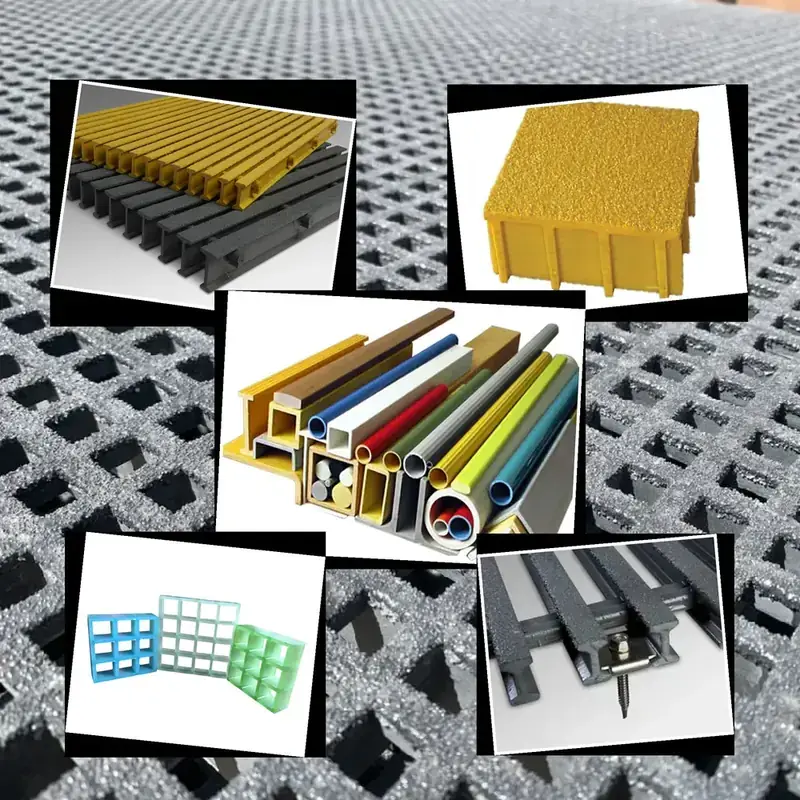
FRP structural profiles — also known as GRP pultruded beams, fiberglass channels, FRP angles or GRP structural sections — are continuous-fiber composite shapes manufactured by the pultrusion process. Glass rovings and mats are pulled through a resin bath and formed into precise, constant-cross-section shapes: I-beams, H-beams, channels, angles, square tubes, round tubes and flat bars.
As a leading FRP profiles manufacturer, ZeAllgrate produces structural pultrusions that combine the high strength-to-weight ratio of fiber composites with the corrosion resistance of engineered thermoset resins. Where steel rusts, aluminum corrodes and wood rots, GRP pultruded sections deliver 20+ years of maintenance-free structural service in the harshest industrial environments.
- I-beams, H-beams, channels, angles, tubes, bars — all standard shapes
- Size range 25 mm to 200 mm; standard lengths 6 m / 12 m
- High glass content (60–70%) for maximum axial strength
- Corrosion-proof: resists acids, alkalis, solvents and salt spray
- Non-conductive, non-magnetic, spark-resistant
FRP Profile Types & Shapes
| Profile Type | Typical Sizes | Common Applications |
|---|---|---|
| I-Beam | 75×50 mm to 200×100 mm | Platform bearers, secondary beams, support frames |
| H-Beam | 100×100 mm to 200×200 mm | Columns, heavy-duty framing, load-bearing walls |
| Channel (C-Channel) | 25×12 mm to 150×50 mm | Purlins, edge beams, grating supports, framing |
| Equal / Unequal Angle | 25×25×3 mm to 150×100×10 mm | Bracing, brackets, equipment supports, ladder rails |
| Square Tube | 25×25 mm to 150×150 mm | Handrail posts, fencing posts, columns, framing |
| Round Tube | 30 mm OD to 100 mm OD | Pipe supports, handrails, guide rails, conduits |
| Flat Bar / Strip | 20×5 mm to 100×15 mm | Kick plates, base plates, bracing, tread nosings |
| Custom Pultrusion | Custom die design | OEM profiles, specialty shapes, window/door sections |
Why Engineers Specify FRP Structural Profiles
High Strength-to-Weight Ratio
FRP profiles have a strength-to-weight ratio up to 4× that of steel. A typical GRP pultruded beam weighs roughly 25–35% of an equivalent steel section — yet delivers usable structural stiffness for spans up to 4–6 m.
Superior Corrosion Resistance
Fiberglass channels and FRP angles resist acids, alkalis, bleach, solvents and saltwater indefinitely. No painting, no galvanizing, no rust-through — ideal for chemical plants, pulp mills and coastal structures.
Electrical & Thermal Insulation
GRP structural sections are non-conductive and have low thermal conductivity. They eliminate thermal bridging and are safe near high-voltage equipment — no grounding required.
Non-Magnetic
FRP structural profiles are completely non-magnetic — essential for MRI rooms, laboratories, mine detectors, defense installations and equipment near sensitive instruments.
Zero Maintenance
GRP pultruded beams never need painting, sandblasting or rust treatment. Color is pigmented through the wall; surface veil provides UV and chemical resistance for decades.
Fabrication-Friendly
FRP angles and channels are cut, drilled and routed with standard carbide tools — no welding sparks, no hot work permits. Field modifications are quick and clean.
FRP Structural Profiles — Size Range & Dimensions
| Parameter | Standard Range | Notes |
|---|---|---|
| Overall Size Range | 25 mm – 200 mm (leg depth / flange width) | Custom dies for non-standard shapes |
| Standard Stock Lengths | 6 m and 12 m | Cut-to-size available free of charge |
| Maximum Pultrusion Length | Up to 20–25 m (by arrangement) | Transport constraints apply |
| Wall Thickness | 3 mm – 10 mm (profile dependent) | Thicker walls available on request |
| Glass Content | 60% – 70% by weight (rovings + mat) | Continuous rovings provide axial strength |
| Resin Systems | Isophthalic Polyester / Vinyl Ester / Polyurethane | VE grade for aggressive chemical service |
| Surface Finish | Mat / tissue veil (smooth, UV-stabilized) | Smooth exterior veil for color and corrosion resistance |
| Colors | Yellow, Gray, Black, Natural (beige) | Custom RAL colors on volume orders |
| Density | ~1.8 – 2.0 g/cm³ | Approximately 1/4 the density of steel |
| Tensile Strength (axial) | 200 – 400 MPa (roving-dominated) | ASTM D638 — section dependent |
| Flexural Strength | 150 – 250 MPa | ASTM D790 — section dependent |
| Flexural Modulus | 10 – 20 GPa | Lower than steel — design for deflection |
Where FRP Structural Profiles Are Specified
Structural & Industrial
- Platform support beams and grating bearers
- Pipe racks and pipe support brackets
- Equipment frames and skid structures
- Cooling tower support structures
- Wastewater treatment tank covers and supports
- Handrail posts and fence framing
Infrastructure & Specialty
- Bridge deck barriers and handrails
- Coastal boardwalk and pier supports
- Electrical substation framing (non-conductive)
- MRI / laboratory frames (non-magnetic)
- Building facades and architectural grilles
- Antenna towers and telecom shelters
Pair FRP structural profiles with FRP grating decking and GRP grating panels for a complete composite structure. Estimate deck loads with our FRP grating weight calculator. Marine-grade profiles are covered in our marine & coastal industry guide.
FRP Profiles vs. Steel Structural Sections
| Attribute | FRP / GRP Structural Profiles | Steel (Galvanized / Stainless) |
|---|---|---|
| Weight (equivalent section) | ~25–35% of steel — 70% lighter | Reference: heavy, requires lifting equipment |
| Corrosion Resistance | Excellent — immune to rust, acids, alkalis, salt spray | Galvanized: rusts within 5–10 years in aggressive service; stainless: pitting in chloride |
| Maintenance | None — 20+ year service life | Periodic painting, galvanizing touch-up, rust treatment |
| Electrical Conductivity | Non-conductive — safe for substations, no grounding | Conductive — requires grounding and insulation |
| Magnetic Properties | Non-magnetic — safe near instruments, MRI | Ferromagnetic — interferes with sensitive equipment |
| Thermal Conductivity | Low (~0.3 W/m·K) — no thermal bridging | High (~50 W/m·K) — heat loss/gain, condensation |
| Absolute Strength | Lower — design deflection governs | Higher — higher load capacity per section depth |
| Upfront Cost | Higher material cost | Lower material cost |
| Life-Cycle Cost (corrosive service) | Lower — zero maintenance, 25-year life | Higher — repainting, replacement, downtime |
Engineering Design Considerations
Design for Deflection
FRP structural profiles have a lower modulus of elasticity (10–20 GPa) than steel (200 GPa). In most structural applications, deflection — not ultimate strength — governs the section size. Our engineering team provides certified section property tables (I, S, A) and can assist with deflection-based sizing.
Connection Details
Bolted connections with SS316 hardware are standard. Use oversized washers to distribute bearing loads. Avoid point loads on thin walls — add stiffeners or use a larger section. Adhesive bonding is also possible for specialist applications.
Resin Selection
Isophthalic polyester for general industrial and water/wastewater. Vinyl ester for chemical processing, bleaching and pulp/paper. Polyurethane for enhanced UV and impact resistance in architectural applications.
Temperature Limits
Continuous service temperature: 60–80 °C for polyester grades, up to 100–120 °C for vinyl ester. Above these temperatures, modulus retention decreases. Consult our engineering team for high-temperature applications.
Frequently Asked Questions
FRP structural profiles (also called GRP pultruded sections) are used as beams, columns, supports, framing and grating bearers in corrosive environments — chemical plants, wastewater treatment, offshore platforms, pulp mills and coastal structures. They replace steel I-beams, channels and angles where rust, weight or electrical conductivity is a concern.
FRP structural profiles are 70% lighter than equivalent steel sections, never rust or corrode, are electrically non-conductive and non-magnetic, and require zero maintenance. Steel profiles are stronger in absolute terms but are heavier, conductive and require painting or galvanizing to resist corrosion.
Standard stock lengths are 6 meters and 12 meters. Custom pultrusion dies can produce continuous lengths up to 20+ meters. All profiles can be cut to size, drilled and fabricated to your drawings at our facility.
Yes. I-beams and H-beams in sizes up to 200 mm depth are commonly used as secondary structural beams, platform bearers, support frames and purlins. Final design must be verified by a structural engineer against certified section properties (moment of inertia, section modulus, allowable deflection).
We stock fiberglass channels and FRP angles from 25 mm up to 150 mm leg depth, with wall thicknesses from 3 mm to 10 mm. Square tubes range from 25×25 mm to 150×150 mm, and round tubes from 30 mm OD to 100 mm OD. Custom dies available for large-volume orders.
Complete Your FRP / GRP Structural System
FRP Grating
View →Molded & pultruded FRP grating panels for decking on your profile-supported structure.
GRP Grating
View →Glass reinforced plastic GRP grating panels — the walking surface for your FRP structure.
Weight Calculator
Open tool →Estimate panel and section weights for shipping and structural loading.
Need FRP Pultruded Beams for Your Structure?
Send us your section sizes, lengths and resin requirements — our engineering team will confirm availability, provide section property data and quote within 24 hours.