
GRP Sheet Piling & FRP Composite Sheet Piles for Riverbank Protection
GRP sheet piles and FRP composite sheet piling are corrosion-proof alternatives to steel and vinyl sheet piles for riverbank stabilization, coastal erosion control and retaining walls. ZeAllgrate's pultruded fiberglass sections never rust in seawater, never need coating, and install with light equipment. The same pultrusion technology behind our GRP grating produces these structural sections.
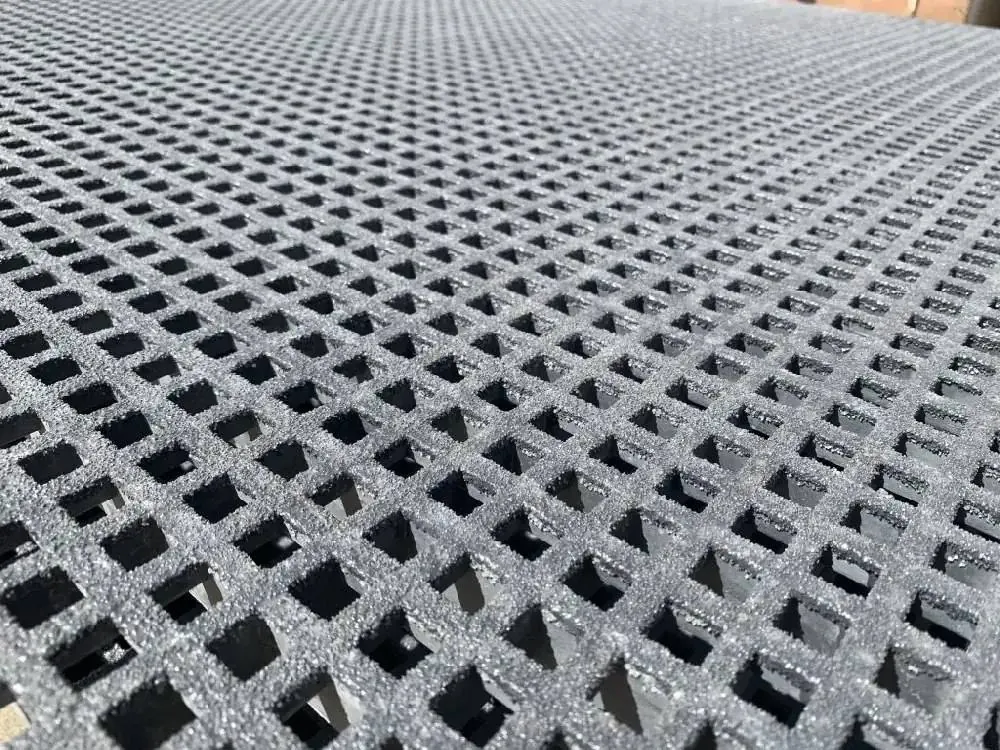
Sheet Piles That Never Rust in Seawater
Steel sheet piling in seawater and brackish water corrodes at 0.1–0.3 mm per year in the splash zone, and coatings fail within 8–12 years. Concrete sheet piles crack from freeze-thaw and sulfate attack. GRP sheet piles — pultruded E-glass in vinylester resin — are immune to chloride corrosion, to H₂S and to most effluents. An FRP composite sheet pile wall is designed for a 50-year service life with zero maintenance, which is why coastal authorities and port engineers are switching.
At roughly 1/5 the density of steel, GRP sheet piles are light enough for two workers to handle and for small excavators or even manual vibratory hammers to drive. There is no need for heavy marine plant on remote river sites. The interlocking pultruded profile forms a watertight wall, and the top can be capped with a concrete walkway or finished with FRP grating decking for an inspection promenade — all fiberglass, no dissimilar metals.
- Immune to seawater, chloride and H₂S corrosion
- 1/5 the weight of steel — light-equipment installation
- No coating, no painting, 50-year design life
- Interlocking profile — watertight, recyclable after service
GRP Sheet Pile Profile Selection
Standard pultruded U-type and Z-type GRP sheet piles are produced in vinylester resin. Section modulus and bending capacity are calculated per your retained height and water level.
| Profile | Width | Typical retained height | Best use |
|---|---|---|---|
| U 400×100 | 400 mm | 2.0–3.5 m | Riverbank, drainage canal |
| Z 500×125 | 500 mm | 3.5–6.0 m | Coastal, quay, cutoff wall |
| U 330×90 (light) | 330 mm | 1.5–2.5 m | Lake, pond, landscape |
| Custom tapered | per drawing | 6–10 m | Deep cutoff, remediation |
All profiles are vinylester resin with a UV-stabilized surface veil. Design calculations follow EN 1997 (EC7) and NAVFAC DM 7.02.
Where FRP Sheet Piling Is Specified
Riverbank stabilization
Eroding banks held without steel rust.
Coastal erosion control
Splash-zone walls immune to salt.
Retaining walls
Lightweight FRP composite retaining sections.
Cutoff & seepage walls
Bent and chemical plant containment.
Dock & marina bulkheads
No electrolysis around boats.
Wastewater lagoons
Resistant to H₂S and effluents.
Corrosion-Free, Fast to Install, Long Life
The corrosive environment that defeats steel sheet piles is exactly where GRP sheet piles excel. In a wastewater treatment plant, the splash zone sees H₂S that converts to sulfuric acid on the wall — steel pits in a decade, vinylester GRP is essentially inert. In a marina, steel bulkheads cause electrolysis that accelerates hull corrosion; an FRP composite wall is non-conductive and cannot drive that galvanic cell. The material also carries no magnetic signature, useful around seismic and monitoring instrumentation.
Installation speed is a hidden economic factor. Because each section is light, a two-person crew with a mini excavator or a quiet vibratory hammer can drive 150–250 m² of wall per day — without the heavy lift barges steel piling demands. On top of the wall, engineers often specify a FRP structural profile cap and a GRP grating walkway for inspection, completing a fully fiberglass structure that will not need repainting for decades.
| Property | Steel sheet pile | GRP / FRP composite pile |
|---|---|---|
| Seawater life | 15–25 yr (with coating) | 50 yr, uncoated |
| Density | 7.85 g/cm³ | ~1.9 g/cm³ |
| Installation plant | Heavy hammer / barge | Mini excavator / hand |
| Electrolysis risk | High in marinas | None — non-conductive |
GRP Sheet Piling FAQ
How deep can GRP sheet piles be driven?
Standard sections suit retained heights up to about 6 m; custom thicker pultruded sections can reach 10 m in soft soils. We design per EC7 and provide section modulus tables.
Is FRP sheet piling as strong as steel?
It is lighter and less stiff per meter, but engineered sections meet the required bending and earth-pressure loads for river and coastal walls — and without the corrosion that cuts steel capacity over time.
Can it be used in drinking water or fish habitats?
Vinylester GRP is inert and leaches nothing; it is approved for potable-water and aquaculture applications where coated steel would introduce corrosion products.
What finishes the top of the wall?
A concrete capping beam or an FRP structural-profile cap, often topped with a GRP grating inspection walkway for long-term access.
Need a sheet pile design or take-off?
Send us the retained height, soil and water level — we return a GRP/FRP composite pile schedule within 48 h.