
Antistatic & Non-Conductive GRP Grating
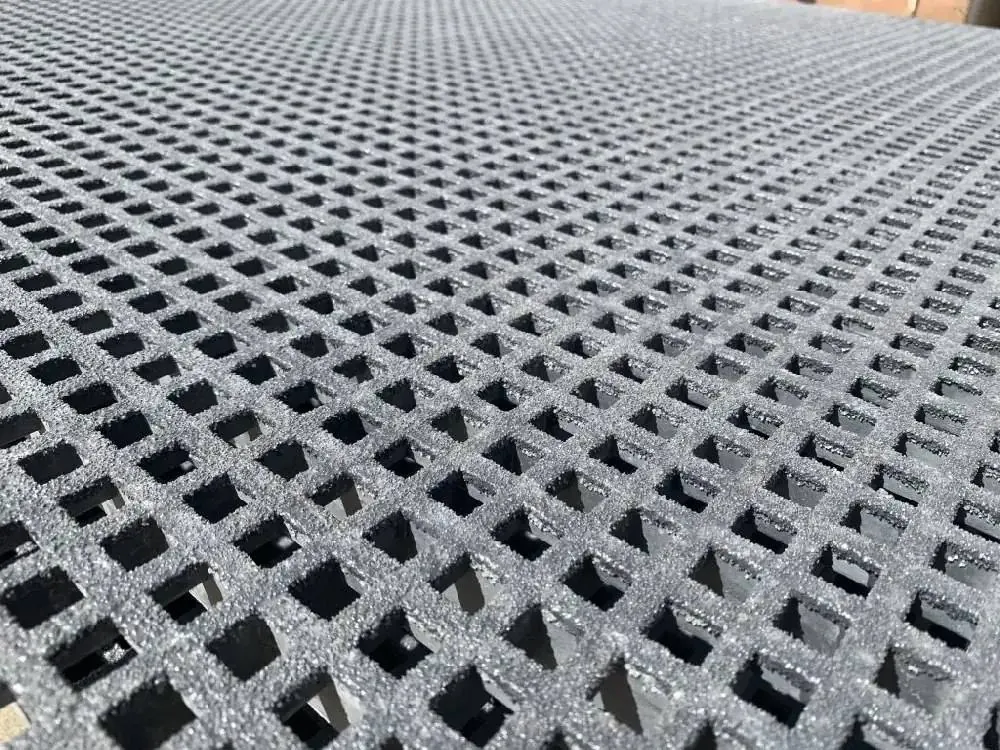
Antistatic & Non-Conductive GRP Grating
ZeAllgrate supplies two electrically-tuned GRP grating grades for areas where a metal floor is a hazard: a non-conductive dielectric grade and a conductive (carbon) static-dissipative grade. Standard molded and pultruded FRP is non-conductive by composition — E-glass fiber in cured resin, with no metal reinforcement — so the deck itself is an insulator for substation walkways, transformer platforms and high-voltage laboratories. Where controlled static dissipation is required, the Conductive (Carbon) resin grade is specified for electrical and explosion-risk areas.
- Non-conductive by composition: glass fiber plus cured resin, no metal reinforcement
- Dielectric deck helps reduce step-potential and touch-voltage risk (characterized under ASTM D149)
- Conductive (Carbon) resin grade: static-dissipative for electrical / explosion-risk areas
- Non-magnetic and spark-resistant walking surface
- GRP panels up to 1220 x 3660 mm; thickness 25 / 30 / 38 / 40 / 50 mm
- Fasteners: SS304 / SS316 clips, the only metal in the walking surface
GRP Grating Configuration Options
| Electrical Grade | Best For | Key Property |
|---|---|---|
| Non-conductive (standard FRP) | Substations, transformers, HV labs, electrical rooms | Dielectric; high volume/surface resistivity when clean and dry |
| Conductive (Carbon) | Electrical / explosion-risk areas | Static-dissipative resin system |
| Grit-top surface | Wet or oily electrical floors | Adds slip grip without compromising the dielectric |
Keep the insulating surface clean and dry: standing water and conductive dust lower surface resistivity, and panels involved in a flashover should be inspected and replaced if a carbon track has formed. Always confirm the final earthing and bonding scheme with the electrical engineer of record — the deck supports, but does not replace, the arc-flash study and live-work procedures.
Where Antistatic / Non-Conductive GRP Grating Is Used
Typical Applications
- Substation walkways and cable trenches
- Transformer access platforms
- High-voltage laboratory platforms
- Electrical room and switchgear flooring
- Microelectronics and cleanroom raised walkways
Standard GRP Panel Data
- Standard panel 1220 x 3660 mm (4' x 12')
- Thickness 25 / 30 / 38 / 40 / 50 mm
- Resin systems: ISO / vinyl ester / phenolic / fire-retardant / UV
- Non-conductive, corrosion-proof, 20+ year service life
- Fixed with SS304 / SS316 clips
- Cut to size and edge-sealed to your drawing
Frequently Asked Questions
It is non-conductive by material composition — glass fiber plus cured resin, with no metal reinforcement. The insulation is inherent to the laminate, not a coating that wears away.
No. Because it is a dielectric, the deck itself does not require grounding as a conductive floor does. The metal fasteners and adjacent steel structure are still handled per site bonding practice.
For electrical and explosion-risk areas we offer a Conductive (Carbon) resin system that is static-dissipative, alongside the standard non-conductive molded and pultruded panels used for dielectric electrical-safety floors.
Standing water, conductive dust, and carbon tracks from arcing. Keep the surface clean and dry, and inspect panels that have been involved in a flashover.
Explore Related GRP Grating
GRP Grating
View →Glass reinforced plastic grating panels and heavy duty GFRP flooring.
Molded FRP Grating
View →Bi-directional molded panels, including the Conductive (Carbon) resin grade.
Pultruded FRP Grating
View →Stiff insulated platforms for long spans and HV areas.
Power & Energy
View →Substation and transformer walkways.
Electrical Insulation Design
View →Design guidance for insulated walking surfaces.
Cleanroom Industry
View →Microelectronics and cleanroom flooring.
Specify Antistatic GRP Grating?
Send us your dimensions, load and environment — we'll confirm availability and pricing within 24 hours.